Designers change the world every day; each decision shapes us and our communities. In healthcare architecture, some of those decisions save lives. In September of 2025, LS3P’s Director of Medical Planning Ron Smith presented to colleagues about his career impact, decisions, and influence. His story reminded us that combined individual actions have collective community power.
The Small Choice That Changed Everything
At a mid-point in his career, Ron found himself at a professional juncture. Ron was a new healthcare architect in Houston, TX, learning all he could about the market (after service in the Peace Corps and then a career building hotels in the Pacific Islands). Excited to dive in, Ron attended his first Academy of Architecture for Health (AAH) conference. There, he volunteered to take over an AAH forum looking for new leadership. Ron’s new volunteer position let him explore his professional passions under an umbrella of shared industry goals and vision. Though he didn’t know it at the time, this opportunity also meant he was now one link in a growing chain of AAH members who nurtured and protected standards that shape infection control, patient safety, and the quality of care in every hospital.
The Landscape of Healthcare History
While it’s easy for me to think of Ron as a timeless national treasure (much like the Grand Canyon) he started working in healthcare architecture decades after the creation of several relevant government programs. One of the biggest impacts on hospitals “BR” (Before Ron), was the Hill-Burton Act. The 1946 Hill-Burton Act responded to the post-World War II need for more and better healthcare. During this time, the Department of Health and Human Services (DHHS) was responsible for monitoring the quality of hospital design and construction. The same year the Hill-Burton Act was introduced a group of architects within the American Institute of Architects (AIA) formed a committee called the AIA Committee on Architecture for Health. This group grew and evolved into an advocacy group, influencing DHHS and its development of Guidelines for the Design and Construction of Healthcare Facilities. Ron’s first healthcare conference just happened to be when the Committee on Architecture for Health officially changed their name to the Academy of Architecture for Health.
When Federal Support Disappeared
In the early 80s, legislation like the Omnibus Budget Reconciliation Act and the Regulatory Relief Program targeted healthcare regulation and funding. There was no longer money to publish the nation’s healthcare guidelines. After what felt like an overnight upheaval, the Committee on Architecture for Health worked with the AIA to carry the costs. The AIA picked up where the federal government left off and began both publishing and selling The Guidelines–charging just enough to break even. To keep up with evolving healthcare and construction fields, the Health Guidelines Review Committee (HGRC) was established. The HGRC helped the AIA update healthcare guidelines accordingly. This multidisciplinary volunteer organization was independent of federal control but was still supported by federal grants. In 1998 the HGRC became part of the new Facilities Guidelines Institute (FGI), publishing the Guidelines under contract with the AIA. These 100 rotating volunteers of the HGRC, spanning the entire healthcare industry, write and maintain the healthcare code used today.
In 2010, Ron was slated as president-elect of the Academy. One day Ron answered the phone to a panicked colleague. This colleague explained that the AIA ended their financial contract with the FGI. The AIA cut funding and severed the formal relationship with The Guidelines as well as the HGRC volunteers. Ending the publication of healthcare standards can literally mean the difference between life and death within a hospital. The Academy joined the frantic search to find new funds as the clock ticked.
As the AIA closed their door to the FGI, the American Society for Health Care Engineering (ASHE) recognized the reality in front of Ron, the Academy, and the rest of the country. ASHE jumped in to finance FGI publication, at the AIA’s loss. Over the years ASHE worked with the FGI to develop the organization we know today. Currently, the FGI is a not-for-profit that is the whole package: it administers, publishes, promotes, and lobbies for The Guidelines. Lobbying for the FGI prioritizes talking to legislatures to encourage them to adopt the guidelines as code in their state.
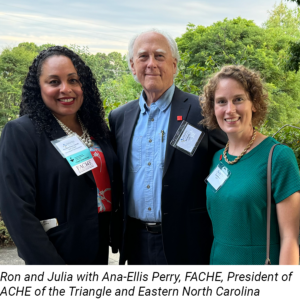
My Takeaway
Within the first three years of my own healthcare architecture career, I saw my home state, North Carolina, adopt the FGI Guidelines as code (one of the now 43 states). Ron’s story reminds me that big change is rarely large-sweeping and immediate (unless enforced federal policy). Change is showing up and making decisions, every day. Following interests can lead to developed passions. Raising our hand is a first step into unimaginable positions of impact and influence.
It is an honor to call Ron Smith a mentor, and it is an honor to write this part of his story. I am newly inspired, and the career decades ahead feel even more exciting. I can hope for and strive towards bettering the world of healthcare architecture. What choices will we make today that impact the future of design?
